- Discover a Historic Castle Town in the Japanese Alps
- Tips for Visiting Matsumoto Castle
- Yorimichi Tip
- How to Pray at a Japanese Shrine
- Shinshu Soba
- Sanzoku-yaki
- Oyaki
- Morning
- Late Morning
- Lunch
- Afternoon
- Evening
- Spring — March to May
- Summer — June to August
- Autumn — September to November
- Winter — December to February
- 1. Wear Comfortable Shoes
- 2. Check Opening Hours and Tickets
- 3. Bring Some Cash
- 4. Respect Shrine Customs
- 5. Use Local Buses When Needed
- 6. Try the Local Food
- 7. Be Mindful of Local Manners
- 8. Enjoy the Seasons
- 9. Learn a Few Japanese Phrases
- What Does “Yorimichi” Mean?
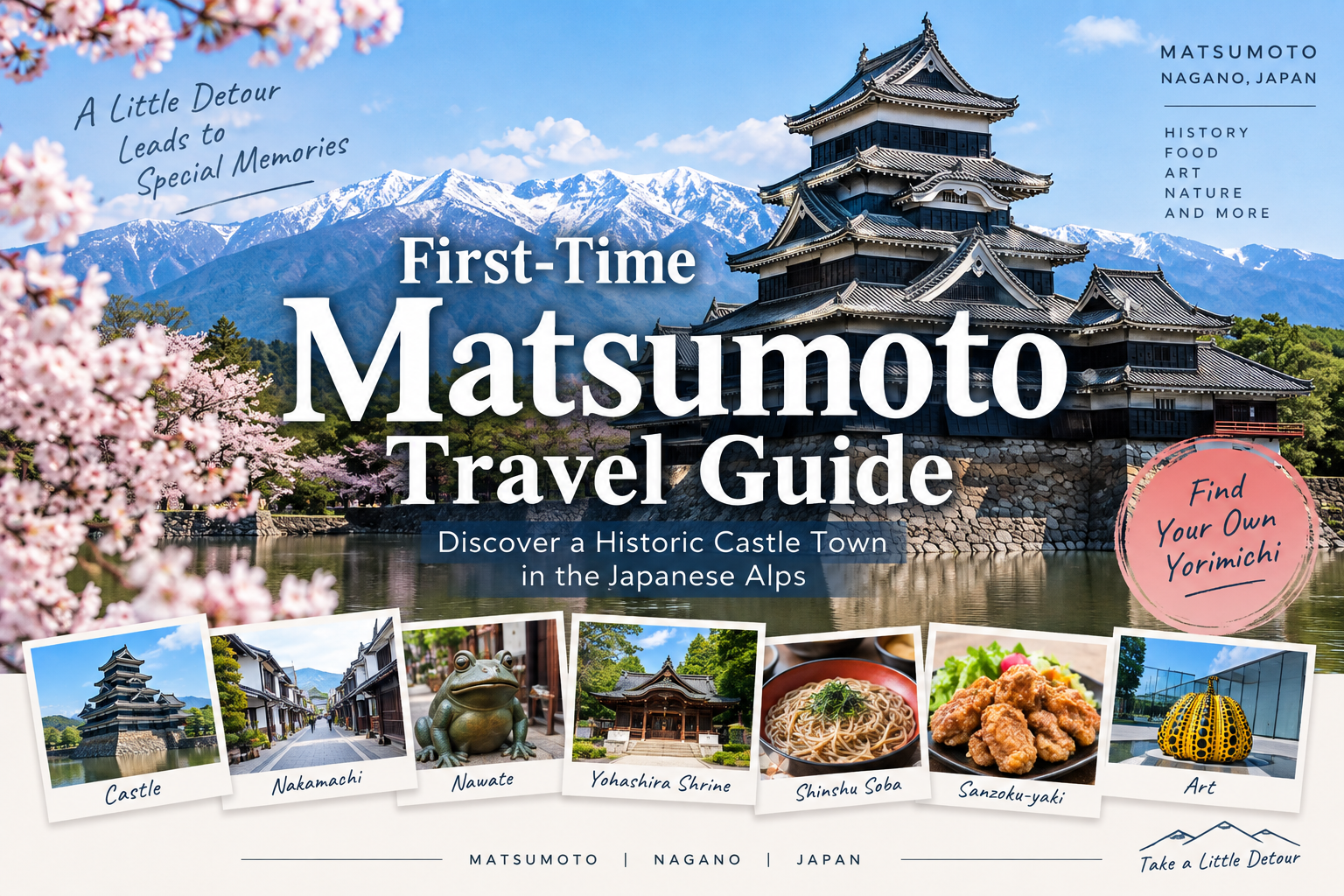
Discover a Historic Castle Town in the Japanese Alps
Welcome to Matsumoto!
Located in Nagano Prefecture and surrounded by the beautiful Japanese Alps, Matsumoto is one of Japan’s most charming historic cities.
The city is best known for the magnificent Matsumoto Castle, but there is much more to discover.
Historic streets, traditional shops, local food, art, cafés, shrines, and beautiful mountain scenery are all part of the Matsumoto experience.
Another great thing about Matsumoto is its compact city center. Many of the main attractions can be reached on foot from Matsumoto Station, making it an easy city to explore even if this is your first visit.
This guide introduces some of the best places to see, things to eat, and experiences to enjoy on your first trip to Matsumoto.
1. Matsumoto Castle — The Symbol of the City
If there is one place you should not miss in Matsumoto, it is Matsumoto Castle.
With its striking black-and-white exterior and the mountains rising in the distance, it creates one of the most memorable views in the city.
Matsumoto Castle is designated as a National Treasure of Japan.
Unlike many reconstructed castles in Japan, its historic wooden keep still survives, and visitors can actually explore the interior.
Tips for Visiting Matsumoto Castle
Outdoor shoes are not allowed inside the castle keep.
At the entrance, you will need to take off your shoes, place them in the bag provided, and carry the bag with you while touring the castle.
The historic wooden stairs inside the castle are also very steep and narrow, so comfortable shoes that are easy to take on and off are recommended.
Please take your time and watch your step as you explore the castle.
The castle’s regular opening hours are from 8:30 a.m. to 5:00 p.m., with last entry at 4:30 p.m.
It is open throughout most of the year but is closed from December 29 to 31.
Admission prices differ depending on whether you purchase a timed-entry e-ticket or a paper ticket at the castle, so please check the official website for the latest information before your visit.
A typical visit inside the castle takes around 45 to 60 minutes.
During busy periods such as Golden Week and the summer holiday season, the castle can become very crowded. Buying a timed-entry e-ticket in advance can make your visit easier.
Matsumoto Castle is about a 15-minute walk from Matsumoto Station.
2. Nawate Street — Frogs, Snacks and Old-Fashioned Charm
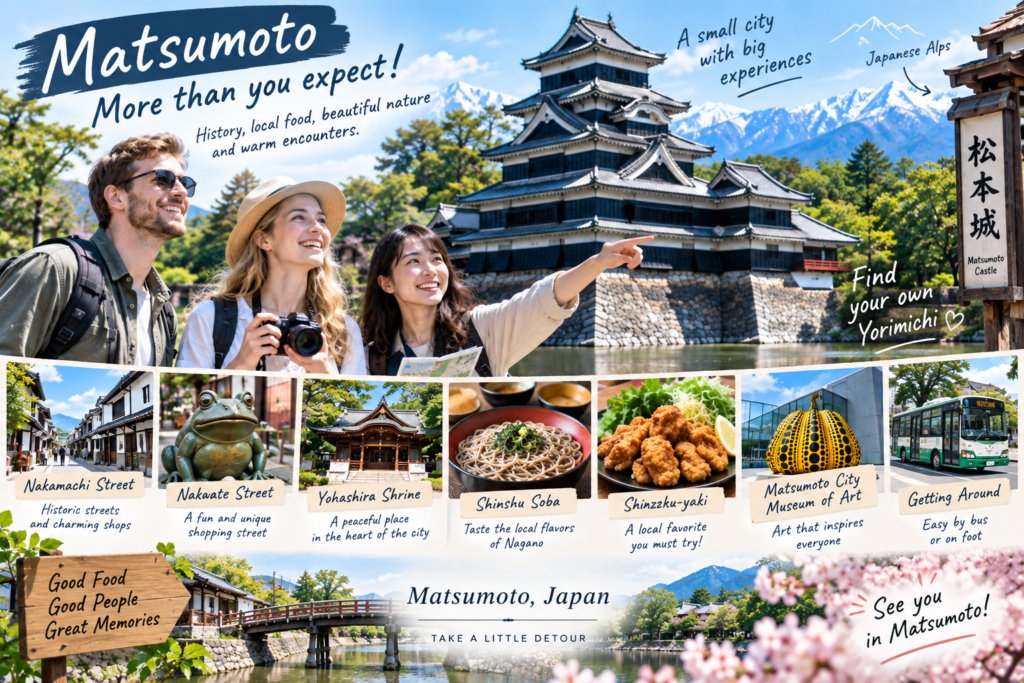
After visiting Matsumoto Castle, take a short walk to Nawate Street.
This small pedestrian street is one of the most enjoyable places to wander around central Matsumoto.
You will notice frogs everywhere — frog statues, decorations and souvenirs have become symbols of the street.
Small shops sell snacks, sweets, souvenirs, miscellaneous goods and local specialties.
The nearby Metoba River adds to the relaxed atmosphere.
Nawate Street is about a 15-minute walk from Matsumoto Station and is easy to combine with Matsumoto Castle and Nakamachi Street.
Yorimichi Tip
Don’t rush through Nawate Street.
Take your time, look inside the little shops, try a snack, and see how many frogs you can find.
Sometimes the best travel memories come from simply wandering without a plan.
3. Yohashira Shrine — A Peaceful Stop in the Heart of Matsumoto
Right next to Nawate Street is Yohashira Shrine.
Although it is located in the center of the city, stepping into the shrine grounds offers a quieter atmosphere away from the surrounding streets.
For international visitors, it is also a nice opportunity to experience a small part of traditional Japanese culture.
How to Pray at a Japanese Shrine
Before praying, you can purify your hands at the water basin near the entrance.
A common way to pray at a Shinto shrine is:
Bow twice → Clap twice → Pray → Bow once
Don’t worry if you do not remember every step perfectly.
Showing respect for the place and local customs is more important than performing the ritual perfectly.
4. Nakamachi Street — Walk Through Matsumoto’s Historic Merchant District
A short walk from Nawate Street brings you to Nakamachi Street.
This area developed as a merchant district during the Edo period.
Today, you can still see traditional storehouses and historic buildings, including distinctive black-and-white namako-kabe walls.
Many of the old buildings have been transformed into cafés, craft shops, restaurants and stores selling locally made products.
Instead of simply walking through, stop for a coffee or step inside one of the small shops.
It is a wonderful place to slow down and experience the atmosphere of old Matsumoto.
Nakamachi Street is approximately a 15-minute walk from Matsumoto Station.
5. Matsumoto City Museum of Art — Discover Matsumoto Through Art
If you enjoy art, make time for the Matsumoto City Museum of Art.
Matsumoto is the hometown of internationally renowned contemporary artist Yayoi Kusama, and the museum has a strong connection with her work.
You can also discover other artists and artworks connected with Matsumoto and the surrounding region.
Opening hours are generally from 9:00 a.m. to 5:00 p.m., with last admission at 4:30 p.m.
Exhibition schedules, closing days and admission fees may change, so check the museum’s official website before visiting.
What Should You Eat in Matsumoto?
Sightseeing is only half the Matsumoto experience.
Food is another great way to discover the culture of Nagano Prefecture.
Here are three local foods worth trying.
Shinshu Soba
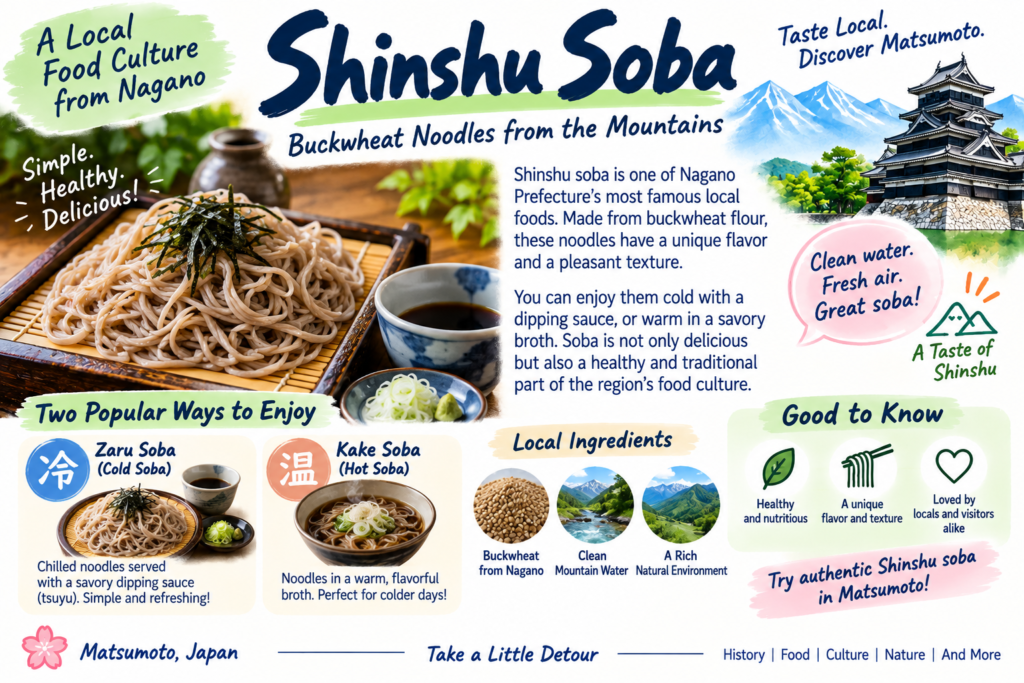
Soba is one of Nagano Prefecture’s best-known foods.
These buckwheat noodles can be served cold with dipping sauce or warm in a flavorful broth.
If this is your first visit to Matsumoto, trying authentic Shinshu soba should definitely be on your list.
Sanzoku-yaki
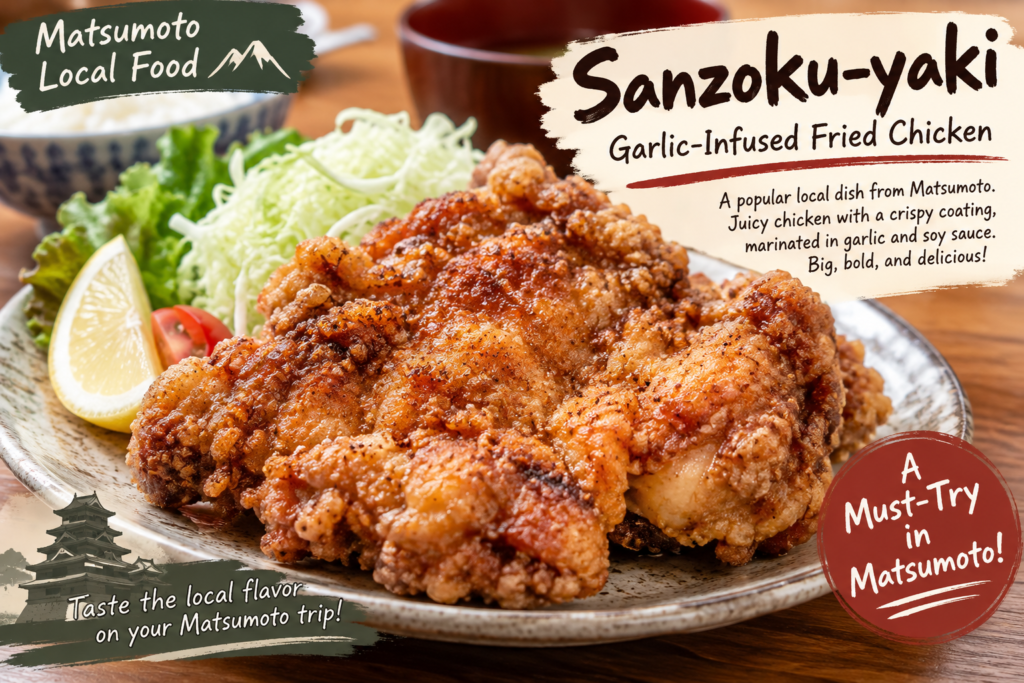
Despite the word yaki, which often means “grilled” in Japanese, Sanzoku-yaki is actually a hearty fried chicken dish.
The chicken is typically marinated with flavors such as garlic and soy sauce, then coated and fried.
It is a well-known local specialty of the Matsumoto and Shiojiri area.
Come hungry — portions can be generous!
Oyaki
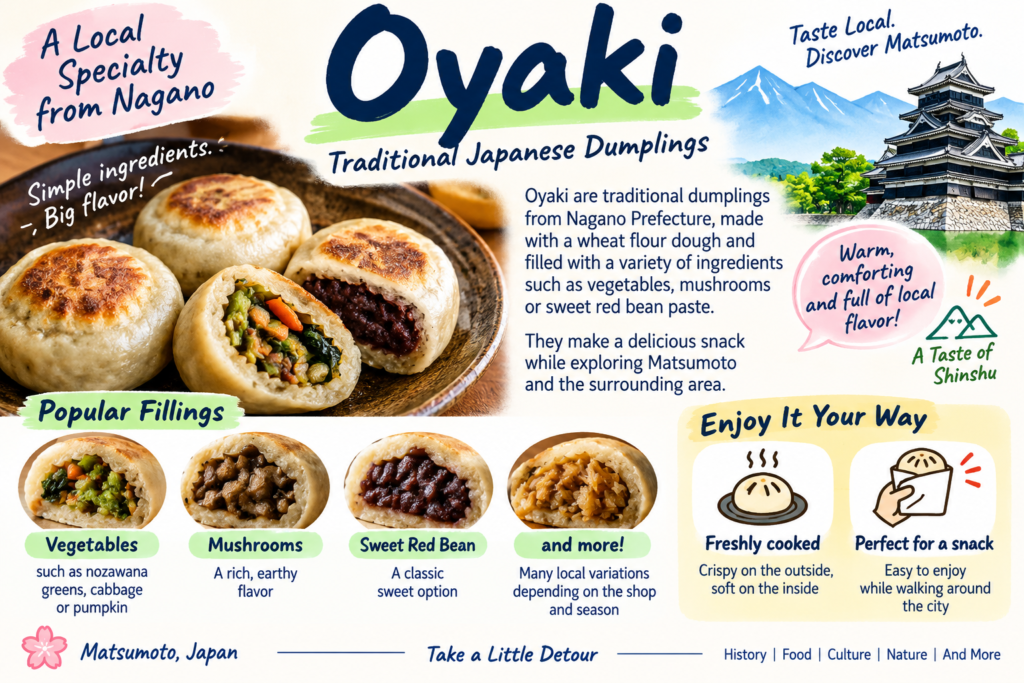
Oyaki is another traditional food from Nagano Prefecture.
These rustic dumplings are made from a flour-based dough and filled with ingredients such as vegetables, mushrooms or sweet red bean paste.
They also make a convenient snack while exploring the city.
Getting Around Matsumoto
Central Matsumoto is relatively compact, and walking is one of the best ways to explore it.
For example, you can easily follow a route such as:
Matsumoto Station
↓
Nakamachi Street
↓
Nawate Street & Yohashira Shrine
↓
Matsumoto Castle
If you prefer not to walk the entire way, local buses are also convenient.
The Town Sneaker sightseeing buses run through central Matsumoto and connect Matsumoto Station with several popular attractions.
Public transportation IC cards such as Suica and Mobile Suica can be used on Gurutto Matsumoto regular bus routes from April 2026.
Routes, schedules and payment methods can change, so check the latest transportation information before traveling.
A Simple One-Day Matsumoto Itinerary
Morning
Arrive at Matsumoto Station and walk toward Matsumoto Castle.
Take your time exploring the historic wooden castle keep and enjoying the views from the castle grounds.
Late Morning
Walk to Nawate Street and Yohashira Shrine.
Browse the small shops, look for the famous frog decorations and enjoy the atmosphere of the old castle town.
Lunch
Try one of Matsumoto’s local specialties.
Shinshu soba and Sanzoku-yaki are both excellent choices for a first visit.
Afternoon
Explore Nakamachi Street.
Take a break at a café, browse local craft shops, and enjoy the traditional architecture.
Then continue to the Matsumoto City Museum of Art.
Evening
Return toward Matsumoto Station and enjoy dinner in the city.
If your schedule allows, consider staying overnight.
Matsumoto is also a convenient base for exploring the Japanese Alps and mountain destinations such as Kamikochi.
When Is the Best Time to Visit Matsumoto?
Matsumoto has four distinct seasons, and each one offers a different experience.
Spring — March to May
Spring brings milder temperatures and beautiful seasonal scenery.
Cherry blossom season is especially popular, particularly around Matsumoto Castle.
Summer — June to August
Summer in the city can be hot, but Matsumoto is a convenient gateway to cooler mountain destinations such as Kamikochi.
The surrounding mountains are beautifully green at this time of year.
Autumn — September to November
Cooler temperatures make autumn an excellent season for walking around the city.
It is also a wonderful time to enjoy colorful autumn leaves in and around Matsumoto.
Winter — December to February
Winters in Matsumoto can be very cold.
However, clear winter skies and snow-covered mountains can create spectacular scenery.
Dress warmly and enjoy a quieter side of the city.
Useful Tips for International Visitors
1. Wear Comfortable Shoes
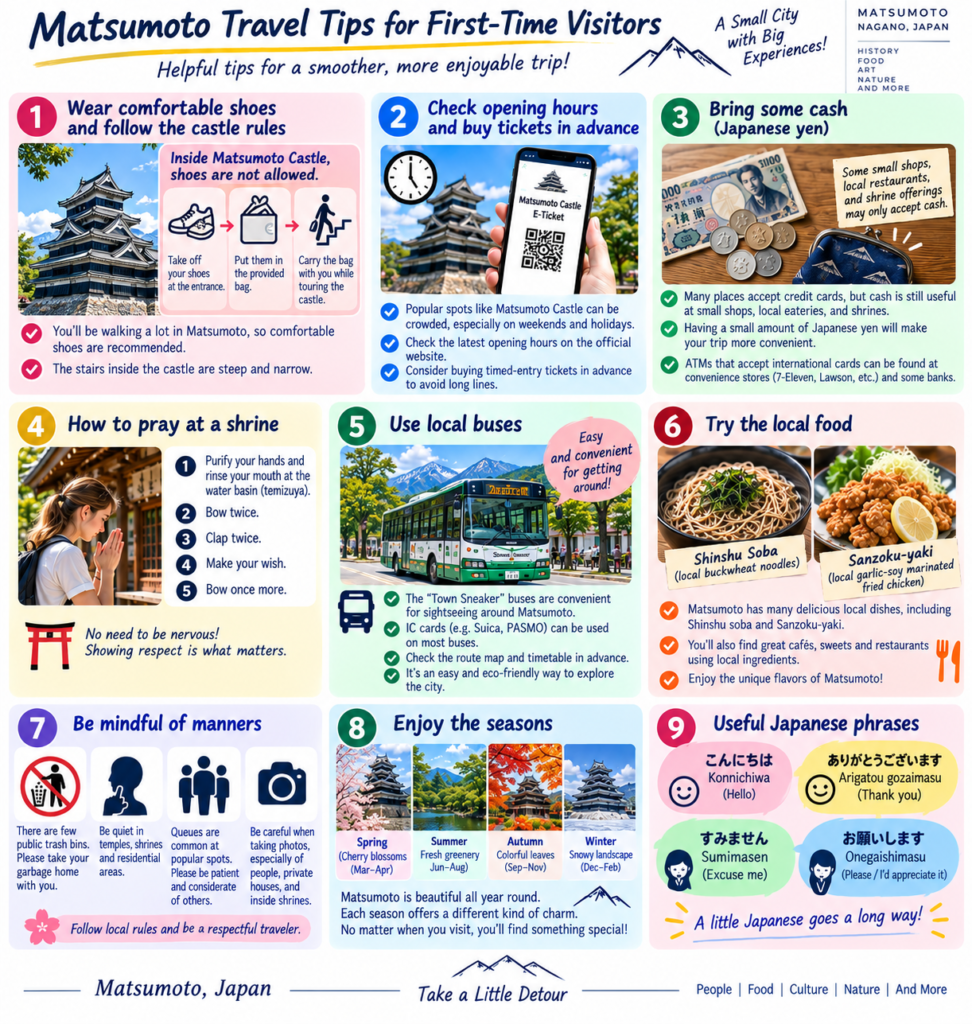
You will probably do a lot of walking in central Matsumoto.
Remember that outdoor shoes are not allowed inside the Matsumoto Castle keep.
You must remove your shoes at the entrance, place them in the provided bag, and carry the bag with you while touring the castle.
The stairs inside are also steep and narrow, so comfortable shoes that are easy to take on and off are a good choice.
2. Check Opening Hours and Tickets
Opening hours and closing days can change depending on the season, holidays or special events.
Check official websites before visiting major attractions.
For Matsumoto Castle, a timed-entry e-ticket can be especially useful during busy periods.
3. Bring Some Cash
Cashless payments are becoming more common in Matsumoto.
However, some small shops and independently owned restaurants may still accept cash only.
It is a good idea to carry some Japanese yen with you.
4. Respect Shrine Customs
When visiting shrines and temples, remember that these are places of worship.
You do not need to perform every custom perfectly.
A respectful attitude is what matters most.
5. Use Local Buses When Needed
The Town Sneaker and other local buses are useful when you want to reduce walking.
Check the route and payment method before boarding.
6. Try the Local Food
Don’t leave Matsumoto without trying at least one local specialty.
Shinshu soba and Sanzoku-yaki — local garlic-and-soy-marinated fried chicken — are two great choices.
7. Be Mindful of Local Manners
Public trash bins can be limited in Japan, so you may need to carry your trash with you until you find an appropriate place to dispose of it.
Please also respect queues, photography rules and quiet areas, especially around shrines, temples and residential neighborhoods.
8. Enjoy the Seasons
Matsumoto changes dramatically throughout the year.
Cherry blossoms in spring, green mountains in summer, colorful leaves in autumn and snowy mountain scenery in winter all offer different reasons to visit.
9. Learn a Few Japanese Phrases
You do not need to speak Japanese to enjoy Matsumoto, but a few simple words can make your trip even more enjoyable.
Konnichiwa — Hello
Arigatou gozaimasu — Thank you
Sumimasen — Excuse me / Sorry
Onegaishimasu — Please / I’d appreciate it
A little Japanese goes a long way!
Why Visit Matsumoto?
Tokyo and Kyoto may be Japan’s most internationally famous destinations.
But Matsumoto offers a different kind of Japanese experience.
A historic castle.
Traditional streets.
Local food.
Contemporary art.
And beautiful mountains.
All of these experiences can be found within a relatively compact city.
You do not always need to rush from one famous attraction to the next.
Turn down a small street.
Step inside a shop that catches your eye.
Try a food you have never heard of before.
Take a little detour.
That little detour might become your favorite memory of Matsumoto.
Welcome to Matsumoto — and enjoy your yorimichi.
What Does “Yorimichi” Mean?
Yorimichi (寄り道) is a Japanese word that means taking a small detour or stopping somewhere along the way instead of going directly to your destination.
When traveling, those unexpected little detours can sometimes lead to the best discoveries.
Take a Little Detour.
Find your own yorimichi in Matsumoto.
Official Information & Useful Links
For the latest opening hours, admission fees, transportation information and other updates, please check the official websites below.
- Visit Matsumoto — Official Tourism Website
- Matsumoto Castle — Official English Website
- Matsumoto City Museum of Art — Official English Website
Information in this article is provided as a travel guide. Opening hours, admission fees, transportation services and other details may change. Please check the official websites for the latest information before your visit.
コメント